
FUN’s digitalization network was established in autumn 2025, with at least one representative from each university library. The network has met three times so far. The most impactful meeting was in May 2026, when every university library had the opportunity to present their university’s or library’s AI solutions. Representatives from eight universities showcased nearly twenty solutions that improve services or the library’s back-end processes.
Commercial vendors’ AI tools—such as Scopus AI, WoS Research Assistant, Keenious, and Alma Metadata Editor—as well as the National Library’s AI frontrunner Finto AI (Annif) have been piloted and are now widely used. Copilot appears to be the most common AI application provided by the universities. Network members are particularly concerned about data protection issues and capacity limitations in its use.
Applications maintained in the university’s own data centers, where confidential data can also be processed, are in use at most universities. Locally maintained applications are developed on a rapid cycle, and thus often look very different from the previous session. Making use of them requires patience and a willingness to experiment. Universities’ local AI services employ several language models, and users can create their own “assistants,” opening up new possibilities for customer support in libraries.
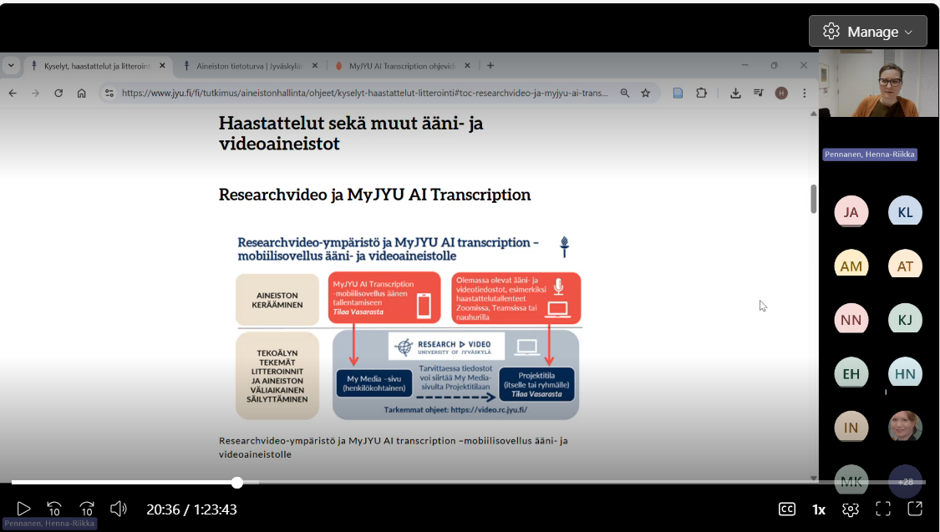
Universities are also developing their own translation and writing assistants, tools to support innovation and invention work, acquisition contract management assistants, and other similar solutions. Bots that read the university intranet are also common. In Jyväskylä, the MyJYU AI Transcription and Researchvideo service suite is available for conducting research interviews. Transcriptions are produced automatically using Whisper. The application places strong emphasis on information security, and Finnish-language transcriptions have been found to be high quality thanks to a model fine-tuned for Finnish. During use, users receive guidance on, among other things, data protection and data retention practices. The implementation leverages synergies with the award-winning Muuttolintujen kevät (Migration Birds Spring) application.
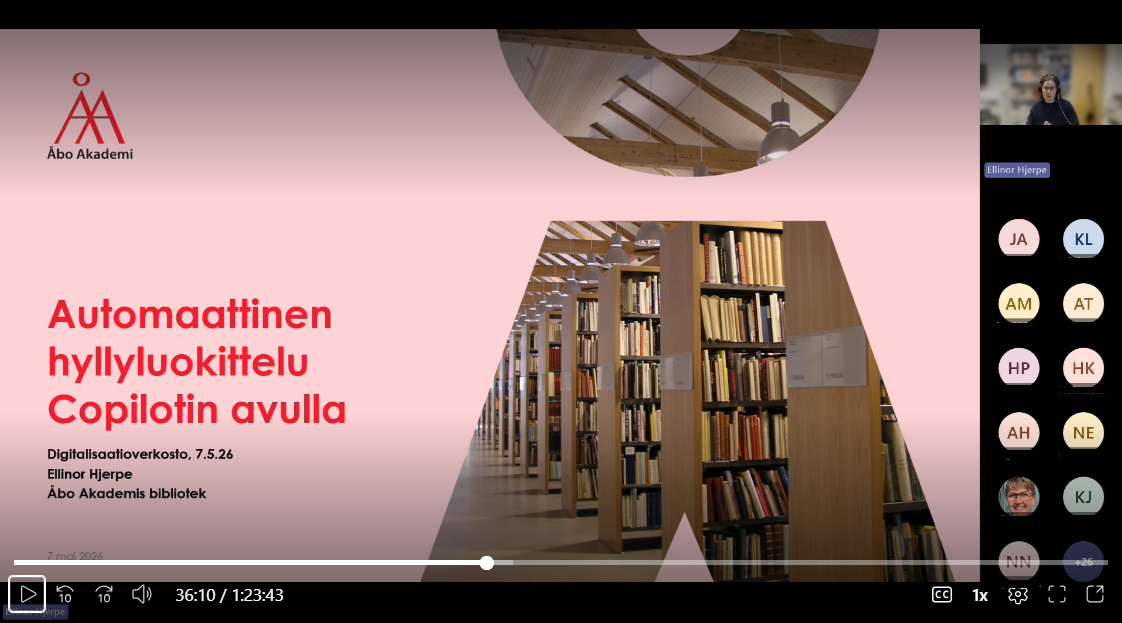
It was interesting to hear concrete examples of how AI is used behind the scenes in library work. At Åbo Akademi, Copilot has been used to automate the definition of new shelf classes for around 15,000 books. At Tampere University, a language model has been used to mine theses for organizational data as well as information on which AI tools were used in their preparation. The University of Turku and Tampere University have piloted DMPAnalyser, developed under the leadership of the University of Turku in collaboration with CSC, which is based on Finland’s evaluation criteria for data management plans.
It was a pleasure to see how well the network’s members have taken ownership of the solutions offered by their universities and how enthusiastically and open-mindedly they have begun to utilize AI applications and language models.
We are also proud of our colleagues’ international recognition! CurreChat, developed at the University of Helsinki, has been selected for the European Commission’s list of the best AI applications for education. Among other things, it allows teachers to embed various AI personas into teaching situations.
This May meeting of our network is a good example that the digitalization of university libraries has not stagnated in the 2010s, at the level of library process management systems or online catalogs. Nor have our experts simply waited for commercial offerings; they have seized the tools at hand and adapted them to their own tasks. The digitalization of university libraries thus continues with a new lease of life, improving our services and empowering our profession.
The meetings of FUN’s digitalization network will continue in the autumn, when we will delve into myths about AI’s carbon footprint and present bad practices and pitfalls to one another through examples. We shall see what there will be to report from those meetings.
Tua Hindersson-Söderholm
Service Manager, Library Services
Aalto University
Heli Kautonen
Library Director
University of Turku Library