
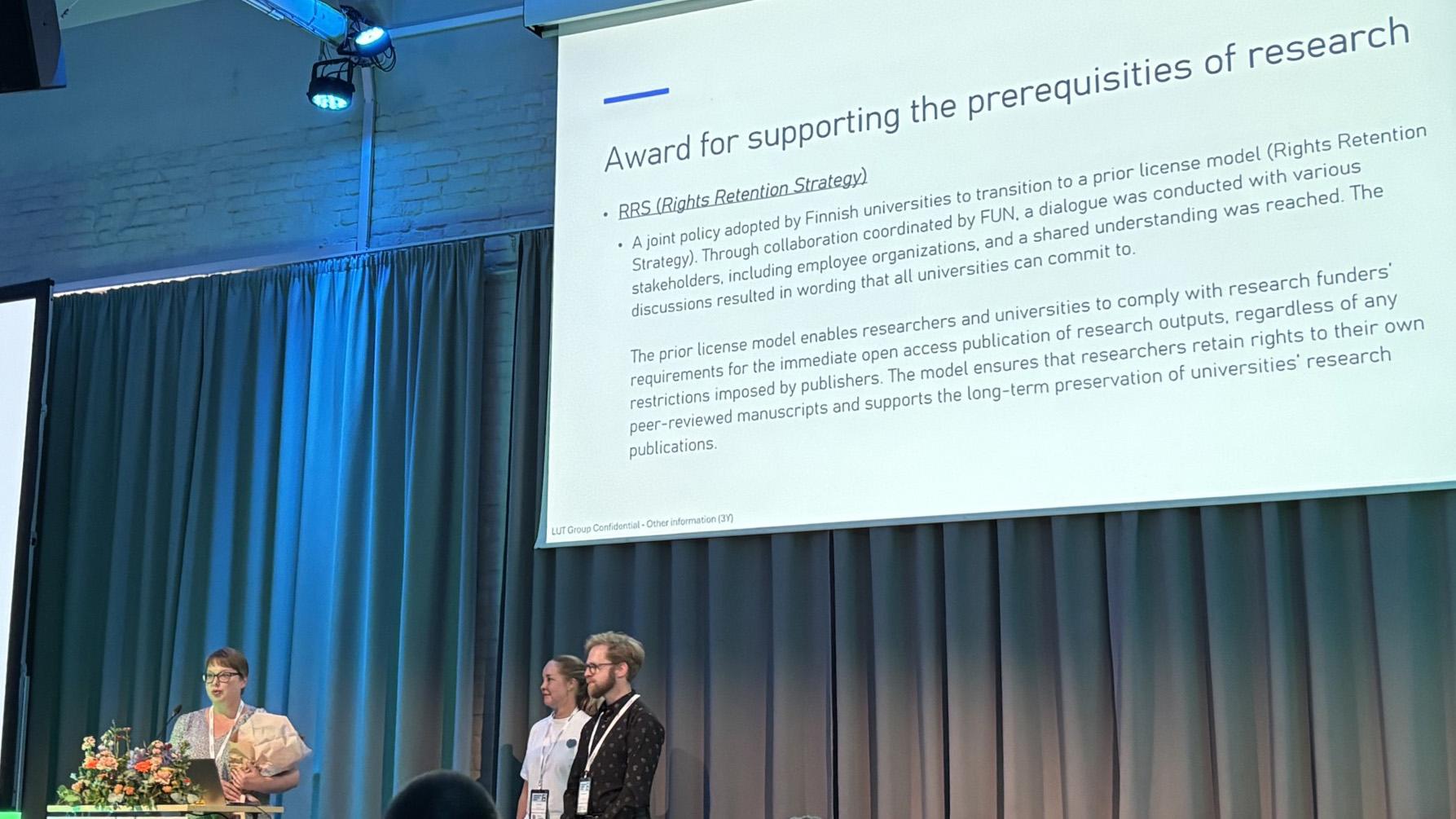
The Finn-ARMA Research Enabler Award 2026 (Tutkimuksen edellytysten edistäjän palkinto) was awarded to the FUN Finnish University Libraries Network in recognition of its initiative, advocacy, and practical implementation of the prior licence model (Rights Retention Strategy, RRS). Irene Ylönen, Director of the University of Eastern Finland Library, accepted the award on behalf of FUN.
The joint decision by Finnish universities to adopt a prior licence model, also known as the Rights Retention Strategy (RRS), ensures that researchers affiliated with a university can make their research publications openly available immediately. By applying a prior licence to their peer-reviewed manuscript, researchers can deposit and publish it in their university’s institutional repository without delay. The model enables researchers and universities to comply with research funders’ requirements for immediate open access to scholarly publications, regardless of restrictions imposed by publishers. It also helps researchers retain rights to their peer-reviewed manuscripts while supporting the long-term preservation of universities’ research outputs.
According to Riitta Lähdemäki, Chair of FUN, similar rights retention models are already in use in many organisations internationally. However, the Finnish approach, implemented collaboratively across the entire university sector, is unique.
“There is strength in collaboration,” Lähdemäki says.
FUN extends its thanks to everyone who contributed to advancing the RRS initiative and fostering collaboration. Special thanks go to the Council of Rectors of Finnish Universities (UNIFI) and to FUN’s RRS Expert Network, which includes experts from all FUN member organisations. FUN also wishes to acknowledge the significant contributions of Mari Aaltonen, Director of Services at the Helsinki University Library and Chair of the RRS Expert Network, as well as the network’s mentors: Tua Hindersson-Söderholm, Head of Library Services at Aalto University; Arto Ikonen, Service Manager at the Open Science Centre, University of Jyväskylä; and Susanna Nykyri, Chief Specialist at Tampere University.